Running
When 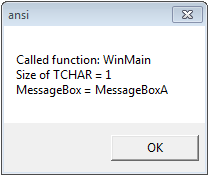
ansi.exe is run, it prints the following message box:
And 
unicode.exe creates this message box: UNICODE and _UNICODE on a Windows C program. tchar.h because it defines _tWinMain depending on UNICODE to either WinMain or wWinMain. Thus, by declaring «our» WinMain as _tWinMain, depending on _UNICODE, either WinMain or wWinMain is called. TCHAR is and how MessageBox is expanded. #include <windows.h>
#include <tchar.h>
#include <strsafe.h>
#define macroToString(macro) expandMacro(macro)
#define expandMacro(macro) TEXT(#macro)
void msg(LPCTSTR calledFunction) {
TCHAR buf[500];
StringCbPrintf(buf, 500,
TEXT("Called function: %s\nSize of TCHAR = %d\nMessageBox = %s"),
calledFunction,
sizeof(TCHAR),
macroToString(MessageBox));
MessageBox(NULL,
buf,
GetCommandLine(),
0
);
}
WINAPI _tWinMain (
HINSTANCE hInstance ,
HINSTANCE hPrevInstance,
LPTSTR lpCmdLine ,
int nShowCmd
) {
msg(macroToString(_tWinMain));
return 0;
}
Makefile creates two versions of the program: ansi.exe and unicode.exe. unicode.exe is produced with _UNICODE and UNICODE defined. all: unicode.exe ansi.exe unicode.exe: unicode.obj @link /nologo unicode.obj user32.lib /OUT:unicode.exe ansi.exe: ansi.obj @link /nologo ansi.obj user32.lib /OUT:ansi.exe unicode.obj: prog.c Makefile @cl /nologo /W3 /DUNICODE /D_UNICODE /c prog.c /Founicode.obj ansi.obj: prog.c Makefile @cl /nologo /W3 /c prog.c /Foansi.obj clean: @del *exe *.obj
ansi.exe is run, it prints the following message box: unicode.exe creates this message box: